Case Study 02: Follow-Up

By Eileen Truax
Article: “Despite TPS stay, thousands of Haitians in Ohio face uncertainty and fear of ICE” Published by: The Guardian Section/Category: US News / Immigration Published Date: February 3, 2026 Author/s: Stephen Starr Link: https://www.theguardian.com/us-news/2026/feb/03/ohio-ice-raids-haitian-community |
1. Context
Focus: The article addresses the impact of fear of ICE raids on the Haitian community in Springfield, Ohio, despite the issuance of a temporary judicial stay of the order terminating Temporary Protected Status (TPS)
Social/political/economic/cultural context:
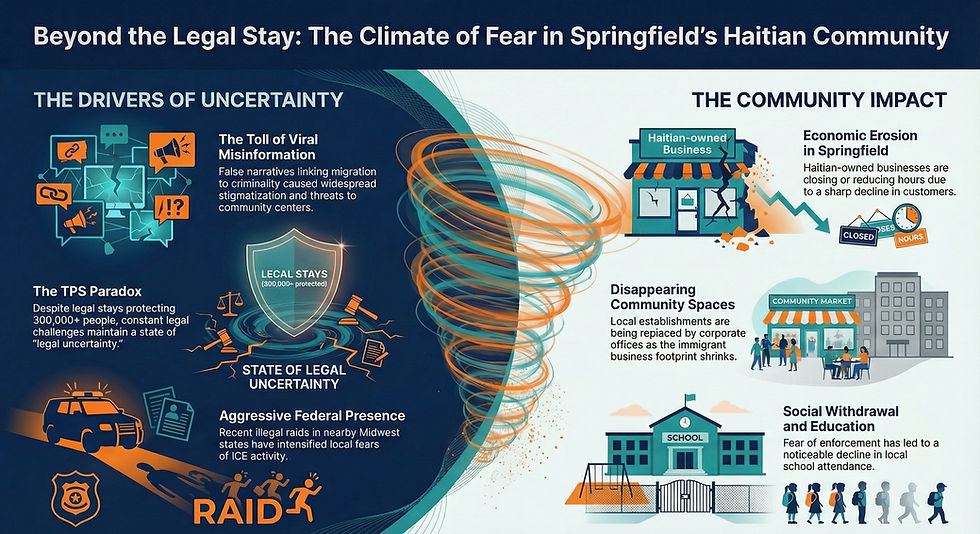
● With the return of Donald Trump's anti-immigrant rhetoric during the 2024 election campaign, narratives linking migration to criminality intensified. During 2024 and 2025, political and media figures spread false claims about Haitian communities that went viral, causing stigmatization in conservative media and social networks.
● Temporary Protected Status (TPS) for Haiti has protected more than 300,000 people at different times since its establishment following the 2010 earthquake. The Trump administration's attempts to end or restrict TPS — temporarily blocked by federal courts — have caused legal uncertainty for communities in states like Ohio, where tens of thousands of Haitians live.
● During the first weeks of 2025, illegal raids by federal government immigration agents have been recorded in other Midwest states, such as Minnesota and Michigan.
Background to the news event:
● As a result of disinformation campaigns and protests by extremist groups in cities such as Springfield, Ohio, there have been threats to businesses, schools, and community centers frequented by Haiti's native community.
● A decline in school attendance and business activity has been reported among immigrants of Haitian origin for fear of ICE raids.
Relevance or topicality of the topic:
● The story links the plight of merchants and the local community to increased misinformation and hardening violence by immigration agents.
● It follows up on a previously reported situation about a vulnerable group (the Haitian community, about which false information was spread during the 2024 election campaign).
2. Narrative structure
Lead: How is the main information presented?
The article's opening section describes a climate of fear and uncertainty among the Haitian community, noting the disappearance of an establishment frequented by this population, even as the headline highlights temporary legal relief.
Body of the note (how does the story develop?):
● Description of how small Haitian-owned businesses—restaurants, food and service stores—have reduced hours or closed temporarily due to declining customers and owners' own fear of exposing themselves to potential immigration agents.
● Use of official data; testimonies of affected citizens; statements by leaders of grassroots organizations; quotes from public officials, demographic statistics.
● Connecting the local case to the national immigration debate, emphasizing the contradictions in the measures put in place by the U.S. government and the consequences of its policies on everyday life – even when a judge has temporarily suspended some of these policies
● Explanation of the political context and reference to recent judicial decisions.
Closing: How does the text end? (With data, reflection, quote?)
● Enumeration of some contributions and achievements of the Haitian community in Ohio, presented as an asset that is at risk of being definitively lost.
3. Use of narrative resources: (descriptions, testimonies, hard data)
● First-person testimonies from affected community members.
● Quantitative and qualitative data (number of people of Haitian origin in the United States, Haitian population in Springfield; description of fear and insecurity also due to the situation in Haiti).
● Narrative transitions that go from national information to local experience, which give rhythm and fluidity to the story.
4. Fonts and voices
Number and type of sources: (official, expert, citizen, documentary)
● Local inhabitants and merchants (direct testimonies).
● Local activists.
● Citations of reports and officials of institutions
● Government Agency Data
Diversity and balance of voices:
● The voice of the people affected (people from the Haitian community) is clearly amplified.
● The legal and judicial arguments and decisions that affect this community are cited.
● Priority is given to voices that demand respect for the right to protection of the Haitian community.
*Important: remember that although there is a cliché that the journalist "gives voice" to people, people have a voice of their own; the journalist only amplifies these voices.
Verifiability: Are sources cited clearly and supported?
● The sources appear well identified and contextualized.
● Verifiable legal and political reports and facts are cited.
5. Language and style
Language resources: (metaphors, adjectives, direct quotes, technicalities)
● Use of evaluative adjectives: "fearful"; "hostile"; "aggressive"; "vulnerable".
● Direct quotes in the first person that bring the reader closer to those who give their testimony.
● Scene description: "Today, the studio has disappeared and has been replaced by an Intuit TurboTax office." ("Today, the studio is gone, replaced by an Intuit TurboTax office.")
● Use of testimonies that describe emotions and generate empathy.
6. Image Use
Photographs/graphics/videos: What function do they serve? Text-image relationship
● It includes a file photograph of a Haitian man's hands in Springfield.
7. Critical analysis
Communicative intention: What do you seek to generate in the reader?
It seeks to generate empathy, question U.S. immigration policy, and evidence the effects of anti-immigrant political discourse on people in the Haitian community.
Potential Impact:
● Generate/reactivate a conversation around the medium and long-term effects of disinformation on the most vulnerable people.
● Influence public opinion on the consequences of migration policies, including whether they are subsequently stopped or reversed.
● Generate empathy through the experience of the most vulnerable people in the community and those who work with them.
Ethical aspects: (privacy, stigmatization, anonymous sources)
● He uses the word "false" every time he refers to rumors spread about the Haitian community.
● It cites information provided by the authority, but specifies that they did not respond to questions sent directly by the publication.
8. Valuation
Strengths of the article:
● It follows up on a very controversial issue, but that came out of the news loop. It shows the long-term consequences that misinformation and anti-immigrant narratives have on communities.
● It humanizes TPS statistics and provides context to understand why these individuals cannot return to their country.
● Good balance between testimonies, experts, and institutional data.
● Good balance between the description of national policies and the effects on the daily life of a local community
Opportunities for improvement:
● A more detailed explanation of what TPS is about could be made for those who know nothing about the program.
● Statistical information on the local economic impact of business closures for the Haitian community could be expanded if the data exists.
● Including recent photographs of the Haitian city and/or community would bring the audience even closer to the reality that the Haitian community faces.


Comments